
Stow-Munroe Falls Board Meeting Tensions Flare Over Late Agenda Items, Imminent 2028 Cash Limits, and Household Tax Levy Costs
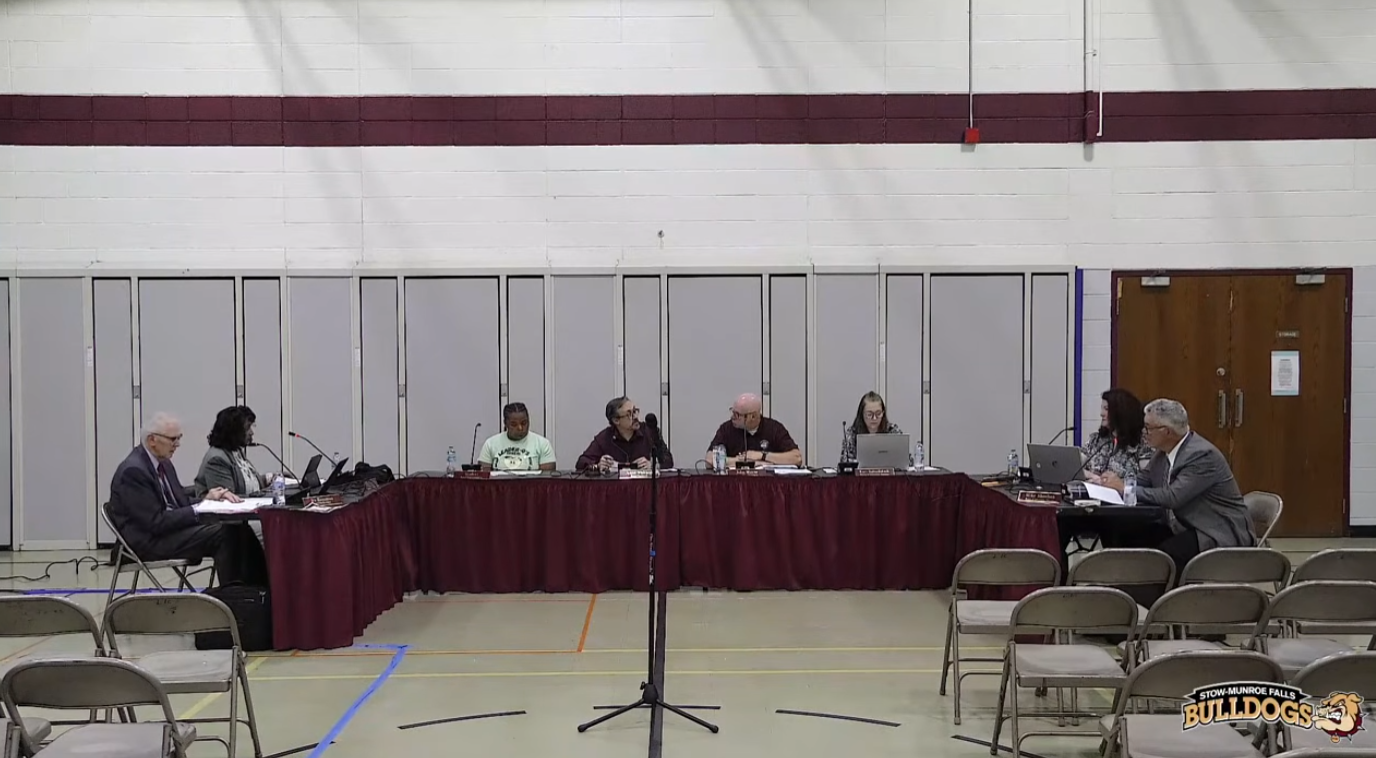
STOW-MUNROE FALLS, Ohio — The Stow-Munroe Falls City School District Board of Education faced a highly charged business meeting on May 18, 2026, highlighted by a sharp procedural clash over agenda management, critical deliberations regarding a potential November tax levy, and the emotional recognition of long-term district staff members entering retirement. Board tensions erupted early in the session during a dispute over a last-minute attempt to introduce nine additional agenda items.
School Board Tensions Flared Over Late Agenda Items
The evening’s most contentious moment unfolded before the agenda could even be officially adopted. Board member Mike Sheehan attempted to amend the evening’s schedule to add nine separate items under section 12C, providing physical copies to the table at the start of the meeting.
Board President Jason Whitacre immediately objected to the additions, prompting a tense constitutional debate regarding administrative authority.
“The board members individually do not possess the authority to add whatever they want to the agenda,” Whitacre said, clarifying that board policy dictates the meeting lineup is established in advance by the superintendent with input from the board president.
Sheehan countered that he had transmitted his items to administrative staff at 10:00 a.m. on the preceding Thursday, arguing that four days should have provided ample time for inclusion.
“We’ve got a full house here of other people and I’m not going to entertain adding those to the agenda at this time,” Whitacre responded, citing procedural courtesy to the board and the public. “We can talk about adding them to the June 8th agenda.”
When Sheehan maintained that several items required immediate attention, Whitacre definitively blocked the inclusion, stating, “Unfortunately, I’m not going to be in a position to add them.”
The board voted 4–1 to adopt the agenda without Sheehan’s additions, with Sheehan casting the lone dissenting vote. The underlying friction resurfaced later in the meeting during an explosive argument where Whitacre called Sheehan’s actions “professionally disrespectful,” prompting Sheehan to state that he was reaching his “breaking point” regarding perceived administrative stonewalling.
Financial Realities and the Cost of a Household Tax Levy
Interim Treasurer Ira Hamman delivered an extensive cash flow projection outlining the district’s looming fiscal cliff. Without an infusion of revenue, the district is officially projected to entirely exhaust its cash reserves by the spring of 2028. Hammond presented several structural scenarios for an upcoming November election to replace an expiring 3.24-mill emergency levy that generates $4.7 million annually.
Board members examined a specialized financial analysis that translated potential ballot millages into tangible out-of-pocket expenses for local families, calculated against the average local home valuation of $280,000:
| Proposed Ballot Millage | Annual Additional Cost to Homeowner | Monthly Additional Cost to Homeowner |
|---|---|---|
| 3.5 Mills | $25.00 | $2.10 |
| 4.0 Mills | $74.00 | $6.17 |
| 5.5 Mills | $221.00 | $18.40 |
The financial data illustrated that a 3.5-mill levy acts almost entirely as a flat baseline continuation of the expiring millage, which currently costs the average household $318 annually. Hammond noted that only the highest 5.5-mill scenario successfully keeps the district entirely out of the red through fiscal year 2030 without necessitating deeper institutional cuts.
“We are in a losing game to start with,” Whitacre remarked, emphasizing that district expenses naturally outpace inflation and flat revenue structures.
The structural realities of declining enrollment further complicated the fiscal outlook. Local resident Marty Simpkins pointed out during public comment that while 380 students graduated in the class of 2026, the incoming kindergarten class sits at just 275 students. Board members noted this structural 100-student deficit could eventually require aggressive long-term consolidations, such as adjusting the district’s building footprint or closing a school facility entirely.
Academic Milestone Recognitions and Staff Transitions
Amid the fiscal anxiety, the meeting paused to celebrate generational milestones and recognize excellence across Northeast Ohio facilities. Principal Nicole Marconi hosted an interactive presentation showcasing Indian Trail Elementary School’s recent academic strides. Second-grade students took over the microphone to demonstrate advanced decoding and reading fluency concepts, reciting classic fables and poems to the audience.
The board also paid tribute to a massive roster of certified and classified retirees, whose collective service spans multiple decades. Among those recognized was Jim Scelza, a legendary high school math educator and baseball coach retiring after an astonishing 41 years of service to the district.
Superintendent Dr. Felisha Gould also announced the hiring of Shawn Doherty as the incoming principal for Riverview Elementary School, filling the vacancy left by the retirement of long-time administrator Tracy Cosme.
Frequently Asked Questions
